Sally Ride: The Woman That Reached For The Stars
Early Life & Education
Sally Kristen Ride was born on May 26th, 1951, in Los Angeles, California. Growing up, her parents encouraged her and her sister to follow their respective interests, and they had a supportive household. Furthermore, Sally mentions that her father was her greatest source of inspiration. As a child, she was incredibly keen on sports, especially tennis. Ever since high school, she aspired to be an astrophysicist. She was admitted to Swarthmore College in Pennsylvania on a full scholarship. She later pursued courses in quantum mechanics and Shakespeare at the University of California, Los Angeles, and was the only woman majoring in physics. She then transferred to Stanford University as a junior, and she graduated in 1973 with a dual degree - a Bachelor of Science degree in physics and a Bachelor of Arts degree in English Literature. She earned a Master of Science degree in physics in 1975 and a Doctor of Philosophy in 1978. Her main areas of study included astrophysics and free-electron lasers.
Ride’s Journey at NASA
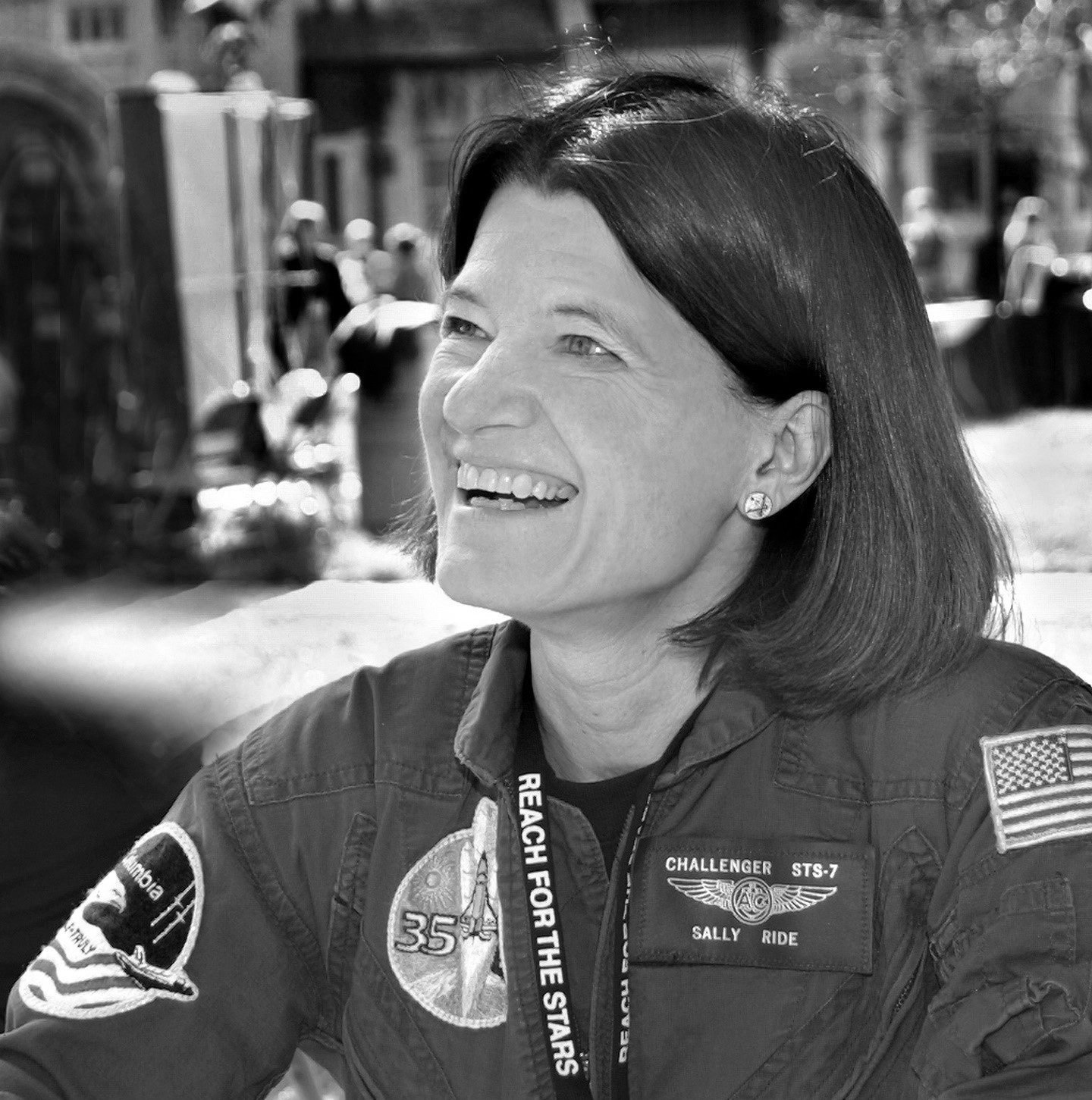
After finding an ad for it in the newspaper, Sally Ride claims to have applied to NASA’s astronaut program. 35 individuals were accepted from a pool of 8000 candidates, and only six of them were women. After she had completed one year of her training and evaluation period, she was eligible for an assignment as a mission specialist on future space shuttle flight crews. Her athletic ability was a major asset during her training period. She worked on the development of the shuttle’s robot arm while in training and simultaneously contributed to the mission control as a capsule communicator (CAPCOM) on the STS-2 and STS-3 missions. Ride was soon to be one of the five crew members aboard the space shuttle Challenger STS-7. History was created by Dr. Sally Kristen Ride on June 18th, 1983, as she became the first American woman in space and the youngest American in space at the time. In this mission, she was the flight engineer, and she launched two communication satellites that were responsible for operating the shuttle’s mechanical arm as well as for conducting experiments. Before her launch, Dr. Ride was interviewed multiple times about her preparation for going to space. Unfortunately, being a woman in a male-dominated industry almost obviously subjected her to misogynistic questions regarding how the space mission was going to affect her ability to reproduce and what kind of makeup she was going to take on the mission. She later commented about this and said, “It’s too bad this is such a big deal. It’s too bad our society isn’t further along.” Ride went on her second shuttle mission, STS-41G, on October 5th, 1984. She worked on refueling techniques for shuttles while also conducting scientific observations of the Earth. She later went on to investigate the Challenger accident of 1986. Further, she became a special assistant to NASA administrators for long-range and strategic planning. She also served as a member of the Review of US Human Spaceflight Plans Committee in 2009. Her contribution to America’s space program is immeasurable and continued until her last breath.
Dr. Ride Pays It Forward
In 2001, Dr. Ride founded Sally Ride Science/ Imaginary Lines, her own company, intending to motivate girls and young women to pursue careers in science, math, and technology. She claims that this was her long-time passion. She wanted to start a company that would dispense good programs in science and provide authentic materials that would stand out to young girls - media that shows both girls and boys a variety of role models with no gender boundaries in various fields, from astrobiology to environmental engineering to rocket science—and change their perception of associating STEM with a particular gender and encourage them to pursue their passion without the fear of restrictions. She herself wrote seven children’s books with space exploration themes.
Superheroines Never Die
Ride met her death at the age of 61 on July 23rd, 2012. She was diagnosed with pancreatic cancer. Though she underwent chemotherapy, radiation, and surgery a short while after, the treatments were not sufficient. Even after her death, Sally’s legacy inspires people to not let any societal bounds stop them from achieving their dreams. She stands as one of the greatest role models for women and young girls in STEM.
Written by Sanjana
References:


Comments
Post a Comment